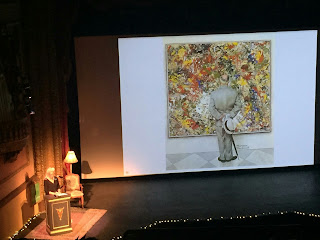
Tuesday, March 05, 2013
Today in the Montana Legislature is a re-enactment of a 1913 legislative session and the rededication of the Charlie Russell painting that graces the House chamber! We're all in period dress. Here I am with some fellow representatives: from left, Tom Woods, Lea Whitford, me, Clarena Brockie, and Jean Price!
Saturday, March 02, 2013
Women Legislators Discuss Budget, Bills
Bozeman Daily Chronicle, Saturday, March 2, 2013--Some of Bozeman’s legislators think a balanced budget is possible, but not if they can’t hold off irresponsible tax cuts and refunds.
On Friday, the Gallatin Valley’s female Democratic legislators expressed frustration as they summarized the first half of the legislative session and outlined their hopes for the outcomes of the second half.
Speaking to around 40 residents in the Bozeman Library
community room, Reps. Kathleen Williams, JP Pomnichowski and Franke
Wilmer said they had worked hard in their committees to keep bad bills
from moving forward, along with trying to get a few of their own bills
passed.
“About three weeks into the session, I was starting to feel a
little like the goalie with 10 kickers in front of me,” Williams said.
“You feel like you’re racing to figure out which issues you should jump
for in your committees and on the floor.”
Together, the three are members of some of the more contentious
committees, including Taxation, Natural Resources, Agriculture and
Fish, Wildlife & Parks.
They’ve all served previously and said they’re discouraged by
some of the poorly written and shortsighted bills, such as those dealing
with voting rights, school choice and sex education.
“There’s a lot of propaganda,” Wilmer said. “On the record,
witnesses claimed that Planned Parenthood’s agenda was to fuel the
abortion industry.”
Williams has been around the Legislature long enough to have
seen the effect of term limits, and she credited some of the dysfunction
to the fact that at least one-third of the legislators are rookies.
“There’s been a change in the functioning of the Legislature:
the ability of people to get up to speed and find out who they’re
willing to trust,” Williams said. “I try to make sure there’s accurate
information, which is incredibly challenging.”
Williams managed one squeaker victory when the House passed her
bill with a 50-48 vote. HB 534 will allow corporations to get credit
for using some resources to further social causes, such as environmental
protection, rather than simply maximizing profits.
But when it comes to state resources, the Taxation committee
has allowed several tax cuts to pass through that the appropriations
committee now has to reconcile with the state budget, Williams said.
Another budget issue is using part of the state’s surplus to
give taxpayers a refund, but some suggestions have Pomnichowski worried.
She supported a bill giving property owners a one-time $400
refund, but it stalled. The bill that Republicans passed would pay out
$104 million the first biennium, and the refund would continue to
increase in following years.
“That’s unsustainable — that’s proposing to spend a bonus that
you don’t know you have,” Pomnichowski said. “But those of us that think
that’s irresponsible are out-numbered.”
There wasn’t much to be proud of coming out of the Natural
Resources or Agriculture committees, Williams said. But the one shining
moment came when they killed a bill that would have opposed Sen. Jon
Tester’s Forest Jobs and Recreation bill.
“That was a real fight. It was very close and there was a lot
of strategy,” Williams said. “There would have been an incredibly
divisive debate on the House floor, and it was better for all involved
that we didn’t have to do that.”
Wilmer said the political balance between the Legislature and
the executive branch means GOP chairmen put off some big money issues —
such as public employee pensions, education funding and Medicaid
expansion that would make an additional 70,000 Montanans eligible for
Medicaid — until other issues are decided.
“They’re held hostage to negotiation and compromise,” Wilmer.
“There’s no way that either party will get 100 percent of what they
want. When they both face that — who’s not going to get what —that’s
what’s in play.”
Tuesday, February 19, 2013
Legislative Day 37, Tuesday, Feb 19
Every day, the Standing Committees of the Montana Legislature meet for hours to hold hearings on bills. The variety is amazing: bills that propose an alternative to the death penalty with life in prison without parole, tax credits for alternative energy systems and energy conservation measures, creating a Parks Board separate from the Fish, Wildlife, and Parks Commission, and the list goes on.
Some ideas are very worthy: expanding the program for school lunches to more kids, increasing funds for public transportation (sometimes the only method of transportation for the disabled or the elderly, who might not have drivers licenses or vehicles, and for students and Montana families for whom the regularity and reliability of public transportation is the surest way of reaching school and work), funding our state computer systems to secure all of the data in state computers (one of my favorites; see my earlier post!), and offering responsible property tax relief to Montanans without jeopardizing the budget in future years.
But some ideas make it out of committee that shouldn't, and that can be pretty painful. Take, for example, House Bill 392, allowing the excavation and sale of paleontological remains (fossils) from Makoshika State Park to benefit the park.
Our state parks (and national parks) are formed to preserve and protect the natural environment for the enjoyment of all of us, and policies to date have secured everything in the parks from anyone's excavation or disturbance or vandalism to those treasures. You can't pick a flower in a national park, for heaven's sake. Nearly everyone has heard the saying, "Take only pictures, leave only footprints" in relation to our state and national parks? Can you imagine Pictograph Caves if someone were allowed to excise the pictographs from the rocks, or Lewis and Clark Caverns if someone were allowed to take the stalagmites and stalactites?
The bill that proposes removal of fossils from Makoshika does say that "antiquities permits may be granted for the excavation and removal of paleontological remains at Makoshika state park for the purpose of selling the paleontological remains and using the revenue from the sale to benefit Makoshika state park" and that "The department may adopt rules establishing conditions for the use of antiquities permits granted", but who's to say that someone could excavate something quite precious and then report they'd found nothing? The dangers of privatizing our public resources are rife in this bill, but it passed the committee and is headed to the full House for a vote.
Some ideas are very worthy: expanding the program for school lunches to more kids, increasing funds for public transportation (sometimes the only method of transportation for the disabled or the elderly, who might not have drivers licenses or vehicles, and for students and Montana families for whom the regularity and reliability of public transportation is the surest way of reaching school and work), funding our state computer systems to secure all of the data in state computers (one of my favorites; see my earlier post!), and offering responsible property tax relief to Montanans without jeopardizing the budget in future years.
But some ideas make it out of committee that shouldn't, and that can be pretty painful. Take, for example, House Bill 392, allowing the excavation and sale of paleontological remains (fossils) from Makoshika State Park to benefit the park.
Our state parks (and national parks) are formed to preserve and protect the natural environment for the enjoyment of all of us, and policies to date have secured everything in the parks from anyone's excavation or disturbance or vandalism to those treasures. You can't pick a flower in a national park, for heaven's sake. Nearly everyone has heard the saying, "Take only pictures, leave only footprints" in relation to our state and national parks? Can you imagine Pictograph Caves if someone were allowed to excise the pictographs from the rocks, or Lewis and Clark Caverns if someone were allowed to take the stalagmites and stalactites?
The bill that proposes removal of fossils from Makoshika does say that "antiquities permits may be granted for the excavation and removal of paleontological remains at Makoshika state park for the purpose of selling the paleontological remains and using the revenue from the sale to benefit Makoshika state park" and that "The department may adopt rules establishing conditions for the use of antiquities permits granted", but who's to say that someone could excavate something quite precious and then report they'd found nothing? The dangers of privatizing our public resources are rife in this bill, but it passed the committee and is headed to the full House for a vote.
Sunday, February 17, 2013
Lawmaker by day, winning artist by night
In the midst of a pretty tough week at the Montana Legislature, I received really good news!
I'm the winner of a poster contest by Intermountain Opera Bozeman for their May production of Romeo and Juliet!
In December, before the start of the legislative session, I began working on a few different designs. I wanted to focus on the story of Romeo and Juliet, and also wanted to produce something eye-catching, geared toward a new and younger audience for opera, and to venture into ground that's not typically what comes to mind around opera. (We think of elaborate stages and costumes, powerful singing, and tragic stories around opera, and I hope a more modern perspective in this poster evokes some interest for Intermountain Opera Bozeman!)
I'm the winner of a poster contest by Intermountain Opera Bozeman for their May production of Romeo and Juliet!
In December, before the start of the legislative session, I began working on a few different designs. I wanted to focus on the story of Romeo and Juliet, and also wanted to produce something eye-catching, geared toward a new and younger audience for opera, and to venture into ground that's not typically what comes to mind around opera. (We think of elaborate stages and costumes, powerful singing, and tragic stories around opera, and I hope a more modern perspective in this poster evokes some interest for Intermountain Opera Bozeman!)
I got the news in an email:
Our judges just finished going over the opera poster
submissions and you are the
winner! Congratulations.
And from the press release:
Congratulations to
the winner of the 2013 Poster Contest, JP Pomnichowski! Her artwork will be
utilized in publicity for our May 2013 performance of Gounod’s Romèo et
Juliette and she will be awarded the prize of $1,000.00.
And this past week in the legislature, I presented House Bill 10, for eight computer and information technology projects (price tag: $20 million) and also two bills in the House Business and Labor committee: to allow wine tastings in wine shops, and to allow port wine (fortified wine) to be sold in wine shops. The hearings were Wednesday, and they went really well. But on Friday, the committee voted against port wine sales. Next week, they'll consider the wine tasting bill. Keep your fingers crossed: this bill could be a wonderful business-building vehicle for wine shops.
More to come, soon. Thanks, everyone.
Monday, February 11, 2013
Old computers, new projects
Are you still working on a computer system that's twenty or thirty years old, a mainframe from the 1980s? Do you know anyone who is?
Updating and upgrading our computers as technology gets better and better is a necessity in our modern society. There are better communications, applications, and connectivity all the time, and it's important--critical, even--that we stay current.
The same applies to state government.
Think of all the critical information in state computers: your personal information, business filing info, bank and credit card numbers; it's an immense amount of data, and an immense responsibility to keep it all safe.
This morning, I presented House Bill 10 to the House Appropriations Long-Range Planning subcommittee.
House Bill 10 is the Information Technology legislation for the 2013 session. In it are contained eight projects to upgrade, update, and improve our computer systems, equipment, communications, software, and databases, and all of them serve Montanans at the state agency level.
Public Safety Communications System--this is the interoperability network of emergency communications that reaches across the state. The dollars we invest at the state level are leveraged eight- to ten-fold with grants from federal dollars. When you call 911, the network that transmits that message and dispatches emergency services must be robust; this appropriation will complete the upgrade. Also, more work and business for Montanans is included; restrictions on how federal grants could be spent have been lifted, and so leases from our own telecomm companies will help flesh out the network.
Statewide Data Protection Initiative--This effort will help to add security and authentication to access data in state computers, and the impetus to act quickly is prompted by recent security breaches in South Carolina, where the Department of Revenue was hacked and peoples' personal information accessed, and by hacks in Utah, Alabama, the Wall Street Journal, and our own Yellowstone County. We need to secure computer data not only with user ID and password, but also with secure ID. We'll also test by trying to hack our own system, in order to find vulnerable points of access. Then we'll fix 'em.
Capitol Complex Maintenance Management System--In 44 buildings and 1.2 million square feet of office space, scheduled maintenance and requests for repairs are currently handled in two rather archaic ways: institutional knowledge of long-time employees who know when boilers were replaced and roofs were reshingled, and by a manual system (paperwork). A computer system to track repairs, labor, and materials will help with efficiency and timing of scheduled maintenance.
Commissioner of Political Practices--This is the division that collects data on elections and candidates, lobbyists and political action committees. The computer system upgrade is half-done, and compatibility and app problems between two separate vendors must be fixed.
Department of Environmental Quality--The Remediation Division Information Management System will replace a 1989 system that runs a Microsoft Access database, and both the system and database are so old that the provider is stopping support. We'll convert to a new system, transfer the existing data as well as maps and geologic data and all the rest for things like cleaning up mine tailings, leaking underground storage tanks, and solvent sites, and we'll be able to view concurrent information, too, like Superfund cleanup data.
Department of Transportation--The IT project is for a new Maintenance Management System to replace another 1980s-era system. The upgrade will convert some manual paperwork-driven processes to a web-based system, so that snowplow drivers, dispatchers, road project workers, etc. can get information in real time, can schedule personnel and equipment for projects, and eliminate duplication with a single point of access.
Secretary of State's office--We'll finish replacing a 1978 mainframe computer system, which will improve efficiency and information access for businesses and citizens. In support of this bill was the Montana Bankers Association, whose members use state-of-the-art computers and systems for financial information and need the same security and services from the state. The system will help with business filings, incorporation documents, etc.
Legislative Services Division--The system and software upgrade will replace a 27-year-old mainframe computer system and outdated and incompatible software (TextDBMS and WordPerfect. WordPerfect! That's an OLD word processing program!) and will also offer some "cross-pollenation" between Legislative Services and Legislative Fiscal Division, a logical connection but one that incompatible systems prohibit now.
The Appropriations Subcommittee will consider the funding requests of all of these projects, make amendments (there are three adjustments, for more and less money, already) and then take action on House Bill 10. Then, the bill goes to the full Appropriations Committee, goes through the same process there, then goes (hopefully) to the full House for debate and vote.
I'm particularly proud to carry House Bill 10, for many reasons: with respect to the Public Safety Communications System, I served as a firefighter/EMT for ten years, and the importance of robust and uninterrupted emergency communications cannot be overstated! When you call 911 for help, emergency services personnel want to help you! Also, in the 2009 Legislative Interim (the period after the legislative session and before the next session convenes) I served on the Capital IT Committee, and heard details about many divisions' computer successes, problems, and needs.
For the security of everyone's personal information, I'm proud to sponsor the legislation for systems and processes that accomplishes secure access and protection of your data.
| Add caption |
So, that's what I did this morning.
This weekend was Governor Bullock's Inaugural Ball. Some pics from the event.
Friday, February 08, 2013
Week 5, 2013 Montana Legislature
Hello, friends!
The work of the 63rd Legislative Session is moving along, and for the first couple weeks, most of the bills were easy code clean-up and enjoyed little controversy and bipartisan support. But now, tougher issues are coming before us. We've heard proposals to limit voting rights and voting access, and to control at the state level public school curricula. The House passed (without my support) using silencers for hunting big game, a resolution to change the redistricting model to favor Republican changes (gerrymandering), and to deny overtime pay to computer professionals. Yes, that's a real bill.
There has been some good work, too; I serve as Vice Chair of the House Taxation committee, and we consider policy on income tax, property tax, and revenue at the state level for all of the services that we Montana citizens expect and enjoy. It is the duty of the House Taxation committee to consider the revenue estimate for the next two years, and to recommend to the legislature as a whole our budget number. We passed the revenue estimate Wednesday, and that's an important step for the legislature to fulfill its one duty: to pass a balanced budget. House Tax considers the revenue estimate, and the House Appropriations committee appropriates, or spends, that money. Each Montana household must balance its books and live within its means, and so does state government.
The House Tax committee has heard individual tax policy ideas, too. A proposal to offer income tax relief sounds like a good idea, until you learn that it would offer just $27 to taxpayers. That bill failed, and other, more meaningful tax relief bills will be proposed in coming weeks. We'll consider them all, always with an eye toward balancing the budget.
Visitors grace the House chamber each day. We had some junior fiddlers entertain us at the start of our floor session, and we've heard the State of the State address from Governor Bullock, the State of Education address by Superintendent Juneau, and the State of the Judiciary address by Chief Justice Mike McGrath.
Thanks, everyone, for all your messages on legislation. The work is intense and frequently difficult, but I love the work! I'm honored to serve you, and please be assured, I'll always do my best for you!
Sunday, January 20, 2013
63rd Montana Legislature, Week One and Week Two
Hello, Blogosphere! It's been a while since I posted; didja miss me?
On Monday, January 7, I took my oath of office to serve a third term in Montana's House of Representatives, and I am so grateful for your support. I'm honored to serve, and I love the hard work of making good public policy. I'll do my best for everyone in Montana, you can be sure.
This session, I'm serving as Vice Chair of the House Taxation committee, and I'm a member of the Natural Resources committee, and also the Fish, Wildlife, and Parks committee. It's a busy schedule, but the policy decisions that come before us are weighty and important; House Tax was in joint meetings with Senate Tax three times these past two weeks for hearings on the revenue estimate, and House FWP has already heard wolf hunting bills. The session is in full swing.
In the first week on Day Four, I presented two bills to the House Business and Labor Committee. This week, Week Two, those two bills passed the House. The bills will transmit to the Senate in late February, and then I'll present the bills to Senate committees and hopefully, the Senate will pass the bills. After that, it's on to the governor's desk, and into law. The bills are brought at the request of the Department of Administration, specifically for the Banking Commissioner, and one proposes changes to the Retail Installment Sales Act, the other, changes to the Consumer Loan Act. In committee, I presented amendments to the Retail Installment Sales Act on behalf of auto dealers and also for banks, and I'll bring amendments to the Consumer Loan Act after discussion in the House during debate. All in all, these two bills will help protect consumers from fraudulent lenders, ensure that basic business practices are followed (like requiring interest to be computed on the principal of the loan, requiring that receipts are dated, and figuring refunds for loans that are paid in full before the final payment is due.)
I'll post updates from the session, so stay tuned. Call (406 444 4800) anytime, or write me a message that'll be delivered to my desk in the House chamber (http://www.leg.mt.gov/css/sessions/63rd/legwebmessage.asp?LegSessID=4175&Name=JP%20POMNICHOWSKI).
I'll be working on legislation and writing on items of interest as the session progresses!
![]() | |
| Oath of office ceremony, Montana House of Representatives. |
![]() |
| With Lieutenant Governor John Walsh (left), Governor Steve Bullock! |
In the first week on Day Four, I presented two bills to the House Business and Labor Committee. This week, Week Two, those two bills passed the House. The bills will transmit to the Senate in late February, and then I'll present the bills to Senate committees and hopefully, the Senate will pass the bills. After that, it's on to the governor's desk, and into law. The bills are brought at the request of the Department of Administration, specifically for the Banking Commissioner, and one proposes changes to the Retail Installment Sales Act, the other, changes to the Consumer Loan Act. In committee, I presented amendments to the Retail Installment Sales Act on behalf of auto dealers and also for banks, and I'll bring amendments to the Consumer Loan Act after discussion in the House during debate. All in all, these two bills will help protect consumers from fraudulent lenders, ensure that basic business practices are followed (like requiring interest to be computed on the principal of the loan, requiring that receipts are dated, and figuring refunds for loans that are paid in full before the final payment is due.)
I'll post updates from the session, so stay tuned. Call (406 444 4800) anytime, or write me a message that'll be delivered to my desk in the House chamber (http://www.leg.mt.gov/css/sessions/63rd/legwebmessage.asp?LegSessID=4175&Name=JP%20POMNICHOWSKI).
I'll be working on legislation and writing on items of interest as the session progresses!